How to Pass a Prop Firm Futures Challenge in 2026 (Without Blowing It)
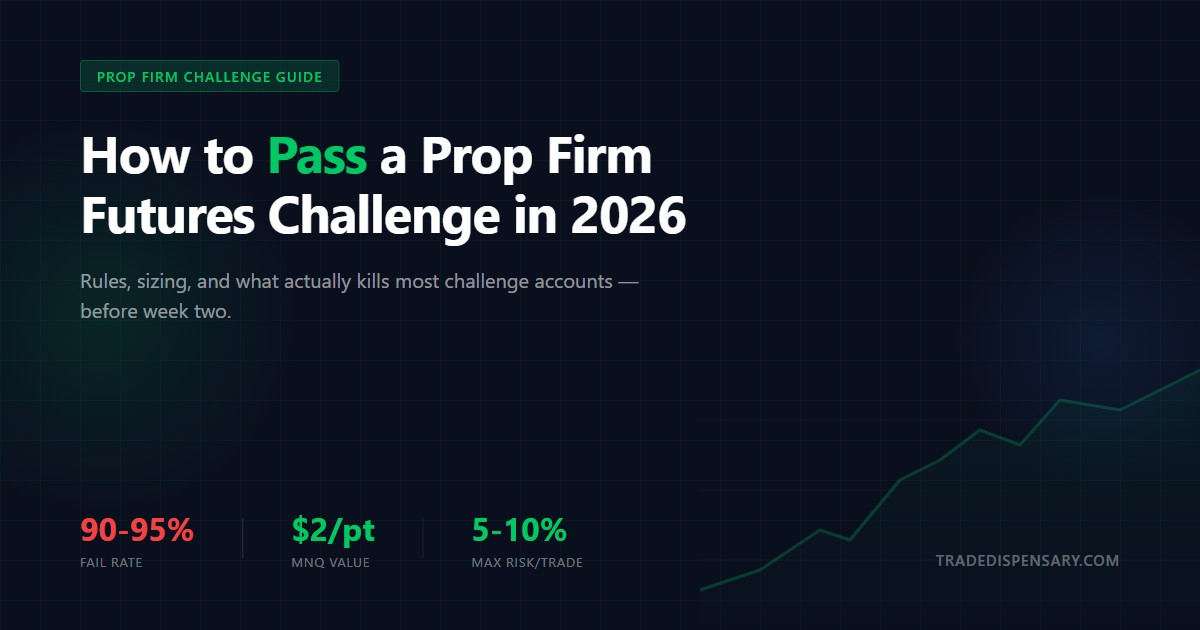
Somewhere around 90-95% of traders fail prop firm challenges. That's not a scare tactic. That's the reality across multiple firms, and it hasn't improved much in 2026. Most blow up in the first week, chasing losses or betting too large on "the trade that will make it all back."
The traders who pass do the opposite. They size smaller than they think they need to. They respect the drawdown limit like it's a hard ceiling. And they don't mistake a three-day winning streak for a signal to press harder.
Here's what actually matters.
What Are the Prop Firm Futures Challenge Rules in 2026?
Prop firm challenges test whether you can hit a profit target while staying inside strict drawdown limits. Every challenge has three levers: a profit goal, a daily loss cap, and a maximum trailing drawdown that follows your equity peak, not your starting balance.
For Topstep's Express Funded Account, the core rules look like this:
- Profit target: Around $3,000 on a $50K account
- Maximum Loss Limit (MLL): Trails from your equity high-water mark, not a fixed amount
- Daily loss limit: Hard stop, varies by account size
- Consistency rule: No single trading day can account for more than 50% of total profits
- Position limits: Contract caps per instrument
- Cutoff times: Certain contracts require you to be flat by 3:10 PM CT
The trailing MLL is what catches most traders off guard. It moves up with your equity peak. If you run your account up $1,500, your floor moves up $1,500 with it. A bad session after a good streak can wipe your entire buffer faster than a fixed drawdown would.
Why Do Most Traders Fail the Prop Firm Challenge?
Over 90% of challenge attempts fail, and industry data suggests only around 7% of funded traders ever receive a payout. The failure usually isn't about strategy. It's about discipline, rule awareness, and position sizing.
The patterns that kill most challenge accounts:
Overtrading in week one. Traders see the profit target and size up to get there fast. A few bad trades later, they've hit the daily loss limit.
Ignoring the consistency rule. You can't bank one massive day and declare the challenge done. If a single day accounts for more than 50% of your total profit, you fail the challenge regardless of your overall P&L.
Trading around news without protection. An unexpected move during FOMC or NFP can hit your daily limit in one candle. Even firms that allow news trading can't protect you from that.
Wrong instrument sizing. MNQ is $2 per point. ES is $50 per point. A trader who sizes the same on ES as they do on MNQ will blow up on the first losing trade.
What Position Size Should You Use for an MNQ or MES Challenge?
Keep your risk per trade at 5 to 10% of your Maximum Loss Limit. On a $50K Topstep account with a $2,000 MLL, that means risking $100 to $200 per trade. For MNQ at $2 per point, one contract with a 50 to 100 point stop fits cleanly inside that range.
Here's how the numbers break down across common prop firm instruments:
| Instrument | Value/Point | 1 Contract, 50pt Stop | 1 Contract, 100pt Stop |
|---|---|---|---|
| MNQ | $2 | $100 | $200 |
| MES | $5 | $250 | $500 |
| MGC | $10 | $500 | $1,000 |
Most traders who pass challenges stick to 1 to 2 contracts throughout. It feels slow. It's the right approach.
If you're copying signals from a signal account into a challenge account, a local trade copier handles proportional sizing automatically. That's covered in the next section.
Can You Use a Trade Copier for a Prop Firm Futures Challenge?
Yes, but only if it runs locally on your own machine. A local MT5 copier connects two terminals directly on your computer with no external servers involved. Cloud-based copiers that route trades through a third party are banned by most prop firms because they involve sharing account access.
Trade Dispensary is a self-hosted MT5 trade copier built for exactly this setup. It runs on your machine, copies trades between your signal account and challenge account in under half a second, and scales lot sizes proportionally based on account balance. No subscriptions. No servers. No third parties.
Here's why it matters for a challenge:
Consistency. You don't manually enter every trade. No missed fills, no errors during a fast market.
Sizing control. Set the copier to scale by balance ratio. If your signal account runs 2 MNQ and your challenge account is half the size, it automatically copies 1 MNQ.
Compliance. Because the copier is local, there's no account-sharing or external routing. You stay on the right side of your firm's rules.
For the full breakdown on compliance, read our guide on local copy trading and prop firm rules. If you're new to the setup, the MT5 copy trading setup guide covers the full configuration process.
The TopstepX Rules That Catch Most Traders Out
Topstep is the most widely used futures prop firm in 2026. A few specific rules catch traders who haven't read the fine print carefully.
The trailing MLL resets at intraday equity peaks, not daily close. Most traders think of drawdown as end-of-day. Topstep's MLL trails your intraday high-water mark. You can gain $500 in the morning, give back $400 by afternoon, and your floor is now $500 higher than when you started the session.
No overnight holds on some contracts. Check your instrument's specific settlement rules. If you're running an EA or copying trades automatically, you need a close-at-time rule built in.
The consistency rule is assessed on net profit, not gross. Track your cumulative daily net profit, not just your winning days. A losing day resets the math.
Algorithmic trading is allowed. Topstep doesn't ban EAs or trade copiers. They monitor for patterns that look like account manipulation, but a legitimate automated strategy running locally is fine.
For TradingView users pushing signals into a TopstepX account via MT5, the guide on connecting TradingView to TopstepX is worth reading before you set up the chain.
A Week-by-Week Strategy for Passing a Futures Challenge
There's no magic system. The plan that works is simple and boring.
Week 1: Don't blow up.
Trade at your normal size. Log every trade. Don't increase size because you're up. Your only goal this week is to not lose more than 25% of your MLL.
Week 2: Manage the consistency rule.
If you made $1,000 in week one, you can't make $2,000 in a single day. Spread your profits. After a strong day, reduce size for the next two or three sessions.
Week 3 and beyond: Protect the lead.
Once you're close to the profit target, trade smaller and less often. You're protecting a margin, not trying to score. Most failed challenges fail in the final few days because someone got impatient.
What Should You Do After Passing the Challenge?
Your first move after passing is to confirm the exact rules for your funded account, because they often differ from the challenge. The MLL may reset to your starting balance. Daily loss limits may change. Contract caps may increase. Get these in writing before you trade a single contract.
Before placing your first funded trade:
- Confirm your new MLL and daily loss limit
- Set platform alerts or hard stops at those levels
- If you're using a copier, verify your lot scaling is correct for the new account size
- Read your firm's copy trading rules one more time before going live
The risk management guide for copy trading covers how to set hard drawdown limits and daily loss stops so they fire automatically, without relying on manual monitoring.
Traders who stay funded long-term treat it like running a business. Rules, documentation, and no improvisation when the morning is going sideways.
Passing a prop firm futures challenge in 2026 comes down to three things: knowing the rules cold, sizing conservatively, and staying consistent when it gets dull.
Trade MNQ or MES to keep per-contract risk manageable. Respect the trailing drawdown. Never let one day account for more than half your profits. And if you're running an automated strategy, a local trade copier handles execution cleanly without compromising prop firm compliance.
Trade Dispensary is a one-time purchase, self-hosted MT5 copier built for exactly this setup. See how it works or grab a license if you're ready to connect your signal account to your challenge account.
Frequently Asked Questions
Can you use automated trading for a prop firm futures challenge?
Yes. Most futures prop firms, including TopstepX, allow algorithmic and automated trading. The main restrictions cover prohibited strategies like latency arbitrage. Standard EAs and local trade copiers running on your own machine are generally permitted. Always verify with your specific firm before starting.
What's the easiest futures prop firm challenge to pass in 2026?
TopstepX's Express Funded Account is widely considered one of the more approachable options because there's no time limit. You pass when you hit the profit target inside the drawdown rules, regardless of how long it takes. Apex Trader Funding runs a similar open-ended format. Neither is easy, but removing the time pressure makes both more achievable.
Can I use a trade copier on a funded prop firm account?
Yes, with conditions. The copier must run locally on your own machine. Cloud-based services that route your trades through external servers are banned by most prop firms because they involve third-party account access. A self-hosted MT5 copier like Trade Dispensary connects two local terminals directly, with no external routing. Always verify your firm's specific terms before setting up.
What is the MNQ tick value for a futures challenge?
MNQ (Micro E-mini Nasdaq-100) is valued at $2 per point, or $0.50 per tick (each tick is 0.25 points). This makes it one of the most accessible instruments for prop firm challenges because per-contract risk is much lower than the full NQ ($20 per point). Most challenge accounts allow at least 5 to 10 MNQ contracts depending on account size.
What happens if you fail a prop firm futures challenge?
You lose your entry fee and need to restart. Some firms offer resets under certain conditions, such as not having exceeded the daily loss limit. Most firms let you repurchase the same challenge, sometimes at a discounted reset fee. A failed challenge isn't lost money. It's practice for when you're running the real funded account.
Tags:
Share this post
Related Posts
Continue learning about copy trading with these related articles: