Prop Firm Payout Rules: Why 10 Funded Accounts Don't Mean 10 Payouts
Risk warning. Trading futures, forex, CFDs and perpetual futures carries a substantial risk of loss and is not suitable for every investor. Most prop firm evaluation accounts do not pass, and most funded accounts never reach a payout. Nothing here is financial advice, a projection of results or a promise that any account will be paid. Payout rules below are summarised from each firm's own published documents and can change without notice, so always read the current version yourself before you plan around it. Always prove any copier, bot or automation on a demo or simulated account before you point it at a live or funded account.
TL;DR
- Payout eligibility is tracked per account, not per trader. Ten funded accounts are ten separate sets of counters, and each one has to satisfy its own rules before it pays anything.
- Copying the same trades to every account does not make them finish together. Different fills, different balances and different reset dates mean the counters drift apart from the first day.
- Consistency rules are the usual blocker. Topstep caps your best day at 40% of net profit on one of its two paths, Apex sets the same cap at 50%, and on Topstep the counter resets to zero after every payout.
- Firms allow copying across your own accounts and not across other people's. Apex permits it between your own PAs and separately forbids accounts being managed by another party or service. Those two statements sit together and catch people out.
- Everything below reflects published rules as at 25 October 2026. Check the current documents, and test any automation on demo first.
Does ten funded accounts mean ten payouts?
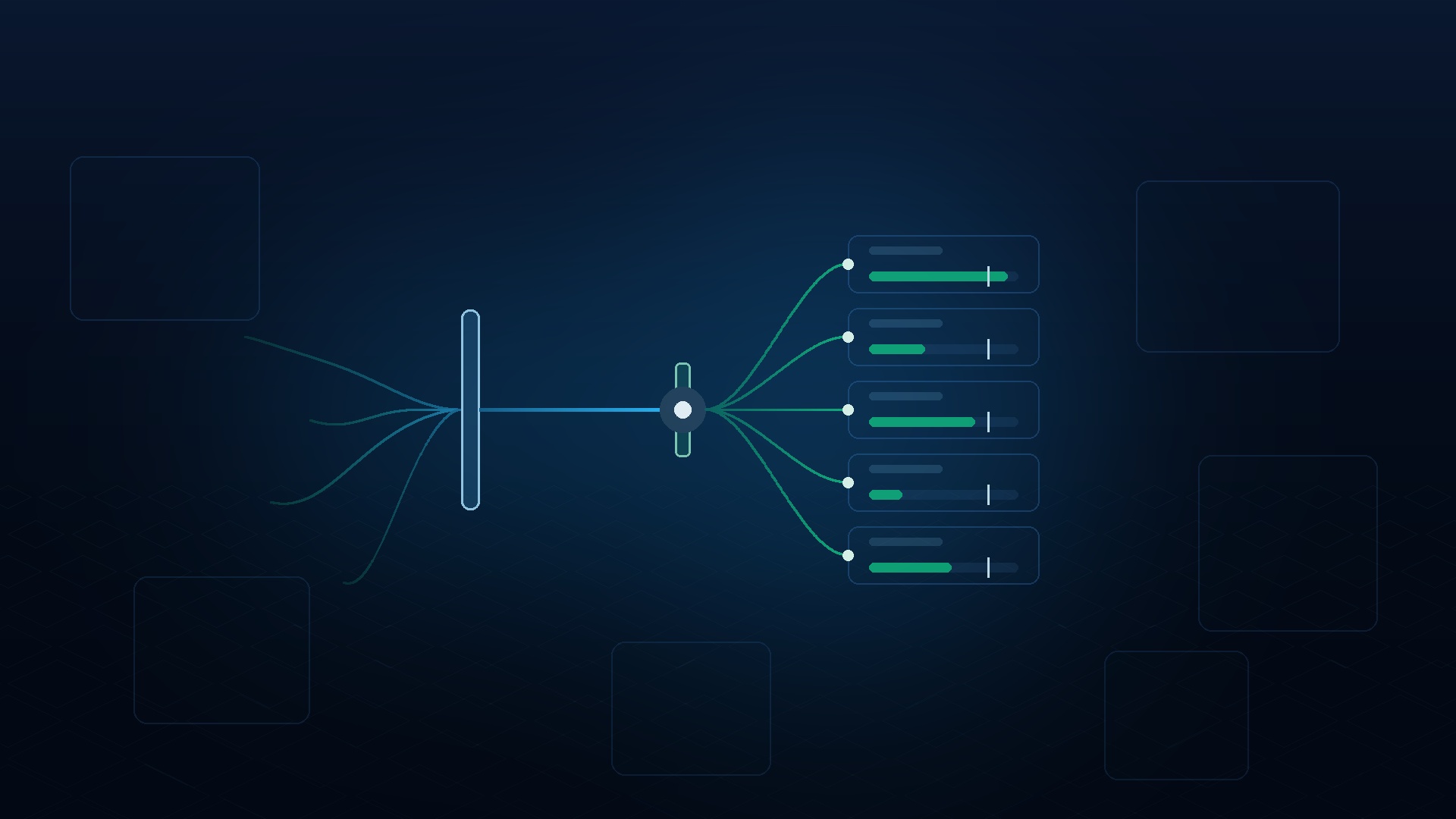
No. Ten funded accounts mean ten separate sets of payout counters, and every one of them has to be satisfied on its own before that account pays anything. A firm does not look at you, it looks at the account. Winning days, consistency, minimum balance and the days since the last withdrawal are all tracked per account, so a payout on one tells you nothing about the other nine.
This is the part that surprises people who have just scaled up. The arithmetic looks linear: pass five evaluations, copy one strategy to all five, collect five payouts. What actually happens is that five sets of counters start drifting apart on day one and reach their thresholds on different dates, in a different order, and some of them not at all.
The drift is not a flaw in the copier. It is a property of the accounts.
Why identical trades produce different payout counters
A copier places the same decision on every account. It cannot make the accounts respond identically, because four things differ between them even when the trade does not.
Fills differ. Each account sits at a different firm, on a different platform, often with a different data route. A market order sent at the same instant can fill at a different price on each. On a strategy with many small trades those differences accumulate into materially different daily totals.
Balances differ. Accounts bought at different times sit at different balances, and several firms require a minimum balance above the starting figure before a withdrawal is allowed. An account that started later, or took one bad day early, is further from that line than its twin.
The clocks differ. Winning day counters, minimum trading day counters and the gap since the last payout all run from each account's own start or its own last withdrawal. Pay one account out and its consistency counter may reset while the others carry on.
Position sizes differ. A $50,000 account and a $150,000 account should not be trading the same contract count. If you size each one properly, the profit on each is a different number, which means the best-day percentage on each is a different number too.
Put those together and the question stops being "when do I get paid" and becomes "when does each of these accounts get paid", which is a different planning problem. Our note on prop firm account limits and copy trading covers how many accounts firms actually let you run at once.
How consistency rules decide which accounts pay
A consistency rule caps how much of your total profit is allowed to come from your single best day. It exists to separate a trader with a repeatable method from one who got a single large result, and it is the most common reason a profitable account cannot withdraw.
Topstep publishes two routes to a payout on a funded account. The standard path asks for five winning days of at least $150 each. The consistency path asks for three winning days where your best day is no more than 40% of your net profit, which gets you to a withdrawal faster if your results are evenly spread. Topstep's own payout article sets out both, along with the rule that a single withdrawal cannot take more than 50% of your account balance.
The detail that matters for multiple accounts is what happens afterwards. On Topstep the consistency calculation resets to zero after every payout, so an account that has just paid out starts its next cycle from nothing while an account that has not paid out yet is still carrying its whole history. Two accounts running identical trades can therefore be in completely different positions on the same morning.
Apex Trader Funding applies a 50% cap and asks for a minimum number of qualifying days before a first withdrawal, with its own schedule for how much can be taken and when, documented in the Apex payouts and withdrawals article. The percentages differ between firms and they change, which is the argument for reading the current document rather than a summary, including this one. We have a longer treatment in prop firm consistency rules explained.
What the firms actually say about copying between your own accounts
Copying your own trades across your own funded accounts is permitted at the major futures firms. What is not permitted is someone else trading your account, or a commercial signal service doing it for you.
Apex states both. It allows copy trading across your own performance accounts, and separately requires that accounts are not "managed or influenced by any other party, person, system, automated trading bot, copy trading service, or trade mirroring software". Read together, the line is between you running your own decisions on your own accounts, which is allowed, and your account being driven by somebody else, which is not. Because those two sentences can be read in more than one way, the sensible move before you scale is to ask the firm in writing and keep the answer.
Two further conditions apply at Apex and are easy to miss. All of your accounts must trade in the same direction, so no hedging one account against another, and there is a household cap on how many active performance accounts you can hold at once, counted across platforms rather than per platform. We cover the firm specifics in Apex Trader Funding and copy trading and the general picture in prop firm copy trading rules.
The practical consequence is that your copier needs to be something you operate, on your own machine, rather than a service that trades for you. That is why Trade Dispensary runs locally with no server in the middle, which we explain in local copy trading for prop firms.
Planning payouts across several accounts
If payout eligibility is per account, the useful thing to track is per account too. Four habits help.
Know each account's worst case before you add another. The best day percentage on each account is a number you can calculate at any time. If one account is sitting at 70% of its profit from a single day, adding a sixth account does not fix it, and trading it harder usually makes it worse.
Size for the account, not for the strategy. Copying a fixed contract count to every account is the fastest way to put a large account under-risked and a small one over-risked. A copier that can scale per destination is doing the arithmetic you would otherwise do by hand, and risk management for copy trading goes through the sizing approaches.
Protect accounts independently. A bad day that breaches one account should not be allowed to breach the rest. Per-account daily loss limits and trailing drawdown limits exist for this, and the point of making them per account is that a breach stops that one and leaves the others trading. See drawdown protection in a trade copier.
Expect the order to change. The account you expect to pay first often does not, because a single strong day on it pushed its consistency percentage out while a quieter account stayed inside the cap. That is the drift working as designed, not a fault.
Putting it together
More accounts multiply the work before they multiply the payout. Each one brings its own counters, its own minimum balance, its own clock and its own consistency percentage, and a copier sends the same trades to all of them without making any of that uniform.
That is a reason to be deliberate about how many accounts you run and how each is sized, not a reason to avoid running more than one. It does mean the honest version of the plan is "five accounts, five separate sets of rules to satisfy" rather than "five times the payout".
Trade Dispensary runs on your own machine, carries no monthly fee, and version 4.37.0 copies from 6 source platforms to 11 destinations with per-account sizing and six independent risk limits on each destination. If you are weighing up how many accounts to run, start with prop firm account limits, and if you are still working through an evaluation, how to pass a futures challenge is the better starting point.
Start on demo. Connect one source and one simulated destination, take a few trades by hand, and watch what arrives on each account before any funded account is involved.
Risk disclaimer. Trading futures, forex, CFDs and leveraged perpetual futures carries a substantial risk of loss and is not suitable for every investor. The majority of prop firm evaluation accounts do not pass, the majority of funded accounts never reach a withdrawal, and past performance never indicates future results. Nothing above is financial advice and nothing above is a projection of earnings. Payout rules, consistency percentages, account caps and copy trading policies are set by each firm, are summarised here from their own published documents as at 25 October 2026, and can change at any time without notice; confirm the current rules with your firm in writing before you plan around them. Trade Dispensary copies orders between platforms, it does not provide trading advice, predict markets or guarantee any outcome, and its risk limits are a safety net rather than a substitute for your firm's own rules. Always test on a demo or simulated account before connecting a live or funded account, and re-test after any update or configuration change. You remain solely responsible for your trading decisions and for meeting the rules of any account you use.
Frequently asked questions
Does having 10 funded accounts mean 10 payouts?
No. Payout eligibility is tracked per account rather than per trader, so ten funded accounts are ten separate sets of counters and each one has to satisfy its own rules before it pays anything. Winning days, consistency percentages, minimum balances and the time since the last withdrawal all run per account. A payout on one account tells you nothing about the other nine.
Why do identical copied trades produce different payout results?
Because four things differ between the accounts even when the trade does not. Fills differ, since each account sits at a different firm on a different platform and a market order can fill at a different price on each. Balances differ, so accounts are different distances from any minimum balance requirement. The clocks differ, because winning day counters and the gap since the last payout run from each account's own history. And position sizes differ if you size each account properly, which changes the best day percentage on each.
What is a prop firm consistency rule?
A consistency rule caps how much of your total profit is allowed to come from your single best day, which separates a repeatable method from one large result. Topstep offers a path requiring three winning days where the best day is no more than 40 percent of net profit, and Apex applies a 50 percent cap. It is the most common reason a profitable account still cannot withdraw.
Can I copy trades between my own prop firm accounts?
At the major futures firms, yes, copying your own trades across your own accounts is permitted. What is not permitted is someone else trading your account or a commercial signal service doing it for you. Apex allows copying across your own performance accounts and separately requires that accounts are not managed or influenced by any other party, person, system, automated trading bot, copy trading service or trade mirroring software. Because those two statements can be read in more than one way, ask your firm in writing before you scale and keep the answer.
How should I size positions across several funded accounts?
Size for the account rather than for the strategy. Copying a fixed contract count to every account under-risks a large account and over-risks a small one, and it also distorts the best day percentage that a consistency rule measures. Use per-destination sizing so each account trades a size appropriate to its own balance, and set per-account loss limits so a breach stops one account and leaves the others trading.
Tags:
Share this post
Related Posts
Continue learning about copy trading with these related articles: