Account Rotator: How to Rotate Trades Across Prop Firm Accounts
Risk warning. Trading futures, forex, CFDs and perpetual futures carries a substantial risk of loss and is not suitable for every investor. Rotating one strategy across several accounts does not reduce that risk, and this article explains why in plain terms. Prop firm rules differ by firm and change without notice, so read your own firm's current rulebook before you automate anything. Always prove a rotator, a bot or any automation on a demo or simulated account before you point it at a funded account.
TL;DR
- An account rotator sends each new trade to the next account in a group instead of to all of them at once. A copier duplicates. A rotator takes turns.
- It does not reduce risk, and anyone telling you it does is selling you something. Fewer trades per account means each trade carries more weight, so each account's result gets more variable, not less.
- What it genuinely does is manage exposure and rule compliance. Lighter order flow per account, staggered evaluation windows, and no two accounts holding the identical position at the identical second.
- Rotation can accidentally create a hedge across your own accounts, which is prohibited at Apex, Tradeify, Lucid and Take Profit Trader. This is the real risk and almost nobody writes about it.
- Only new entries rotate. Exits, scale-ins and partial closes always go to the account actually holding the position, so a trade can never be stranded without a way out.
- Trade Dispensary's Rotator shipped in version 4.52.0 with three selection modes, mixed platforms in one group, and a one-time licence with no monthly fee.
If you run five funded accounts on one strategy, a trade copier opens five positions. That is the point of a copier and it works. But it also means five accounts hit the same drawdown on the same bad morning, five accounts show an identical trade history, and five accounts are exposed to the same single decision at the same instant.
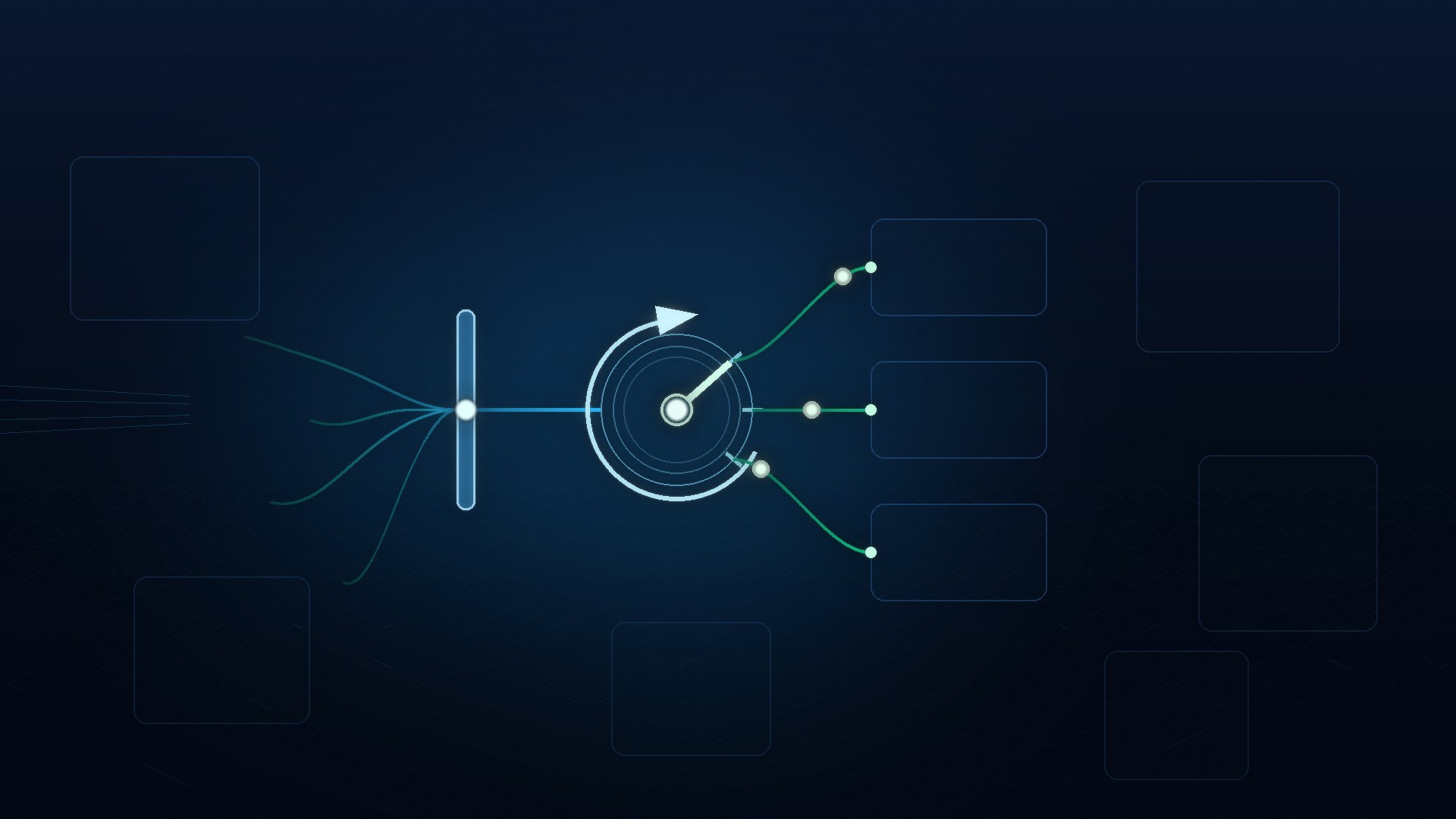
An account rotator answers a different question. Instead of asking "how do I get this trade onto every account", it asks "which one account should take this trade". The next signal goes to the next account. The strategy gets spread across the group rather than copied onto each member of it.
That distinction matters most to three groups: futures traders running several evaluations at once, prop firm traders working inside contract caps and consistency rules, and CFD or forex traders who want one strategy spread over accounts at different brokers. This article covers what rotation actually does, the five use cases that hold up, and the one way it can quietly break a prop firm rule.
What is an account rotator, and how is it different from a trade copier?
An account rotator is software that distributes new trades one at a time across a group of trading accounts, rather than copying every trade to all of them. A trade copier duplicates a signal onto every linked account simultaneously. A rotator sends signal one to account A, signal two to account B, signal three to account C, then returns to A.
The simplest way to see the difference is in the trade count. Say your strategy fires ninety entries in a month across three accounts.
| Trade copier | Account rotator | |
|---|---|---|
| Trades on account A | 90 | 30 |
| Trades on account B | 90 | 30 |
| Trades on account C | 90 | 30 |
| Total positions opened | 270 | 90 |
| Accounts holding the same trade | All three | One |
Both columns run the same strategy. The copier runs it three times. The rotator runs it once and splits the output. Everything that follows comes from that single structural fact.
In Trade Dispensary, a rotator is a named group of copy rules, not of accounts. That sounds like a technical detail and it is actually what makes the feature flexible. A copy rule already carries one destination, one symbol mapping and one sizing setting. So grouping rules means a Topstep account, an MT5 account and a Bybit account can all take turns inside the same rotator with no extra configuration. Each rule still decides what the trade looks like. The rotator only decides whose turn it is.
Does rotating trades across accounts reduce risk?
No. Rotation does not reduce risk, and in one specific sense it increases it. Each account now sees a subsample of the strategy instead of all of it, so fewer trades carry each account's result. Fewer trades means more of the outcome rests on each one, which makes the per-account result more variable, not less.
This is worth being blunt about, because rotation is almost always sold on the phrase "spreading risk". A vendor comparison of copiers and rotators describes the purpose as to "spread trading activity and risk across accounts rather than concentrate it", which is a fair description of what happens. The problem is how traders read it. Spreading is not reducing.
If your strategy has a losing week, rotating it does not produce fewer losses. It deals the same losses out to different accounts. The account that happens to receive the worst three in a row ends up in a worse position than it would have been holding a representative sample of everything.
Trade Dispensary's own documentation says this in writing rather than hiding it, because a trader who buys a rotator expecting protection will size positions as though they are protected. The rule is simple: decide position size and risk per account exactly as you would without a rotator. If a 2 contract position was correct on an account before, it is still correct now. Rotation changes where trades land, not how much a loss costs.
If risk reduction is what you are after, the mechanisms that genuinely do it are sizing, a daily loss limit and a hard stop on every entry. We cover those properly in risk management for copy trading, and the account level guards in drawdown protection for prop accounts. A rotator is a distribution tool. Treating it as a safety feature is the single most expensive misunderstanding available here.
Five reasons futures and prop traders rotate anyway
So if it does not reduce risk, why use it? Because exposure, order flow and rule compliance are separate problems from risk, and rotation is genuinely useful on all three.
1. Staying inside per-account contract caps. Prop firms cap how many contracts an account may hold, and the cap is tied to account size and scaling level. Topstep's contract limits are enforced by the platform itself, and scaling plans at firms like Apex start a new account at a small position size before unlocking more. If your strategy wants 6 contracts and each account is capped at 2, a copier gives you three accounts each refusing the size you asked for. A rotator gives you three accounts each taking a complete trade in turn. More detail on the caps themselves in prop firm account limits.
2. Staggering evaluation windows. If you bought three evaluations on three different dates, they are at different points in their profit targets and their drawdown buffers. Copying every trade to all three drives them in lockstep, which means one bad session can break all three at once. Rotating gives each account a different slice of the same strategy, so a single catastrophic trade lands on one account rather than every account you own.
3. Keeping order flow lighter on any one account. Prop firms watch for patterns. Thirty entries a day on a single funded account looks different from ten entries a day across three. This is not about hiding anything, and you should never try to hide anything, but order flow is a thing firms measure and a rotator is the honest way to keep it proportionate. Our guide on copy trading without getting flagged covers what firms actually look at.
4. Spreading across platforms and brokers. CFD and forex traders often hold accounts at several brokers with different spreads, different execution and different fill quality. Rotating across them means one strategy runs continuously while no single broker relationship carries all of it. Because rotator members are copy rules, a group can mix MT5, cTrader, TradeLocker and a futures platform freely. See multi-platform copying for what can be mixed.
5. Not holding the same position twice at the same second. Two accounts in the identical trade at the identical moment are correlated by construction. Some traders simply do not want that, whether for rule reasons, psychological reasons or because they are testing a strategy's consistency across accounts rather than its total return.
Notice what every one of those five has in common. None of them is "it loses less money". They are all about where exposure sits and which rules apply to it.
Can an account rotator break your prop firm's hedging rule?
Yes, and this is the most important paragraph in this article. If one rotated account ends up long and another ends up short on the same or a correlated instrument, you are holding opposite positions across your own accounts, which most futures prop firms prohibit outright.
The rules are explicit. A survey of prop firm copier rules records three firms saying it in their own words:
- Apex Trader Funding requires that all performance accounts trade in the same direction, and forbids holding opposite positions.
- Tradeify states that hedging the same or correlated products across your accounts is prohibited.
- Lucid Trading states that hedging is prohibited, including across your own accounts.
Take Profit Trader carries a similar restriction. Note what this means: copying in the same direction is broadly permitted at these firms. Holding both sides is not. A rotator sits right on that line.
There are two ways a rotator can produce that state without you intending it:
- A strategy that can hold both directions. If your source can be long and short at once, or flips direction while a position is still open elsewhere, rotation can place the long on one account and the short on another. The copier version of this would have put both on both accounts, which is a different rule problem but not a hedge across accounts.
- A reverse direction setting on one member rule. Trade Dispensary lets an individual copy rule reverse direction, which is a legitimate feature on its own. Inside a rotator, a reversed member will take its turn on the opposite side of everything else in the group. That is a hedge, built by configuration rather than by intent.
The fix is a configuration check, not a software change. Before you enable a rotator on funded accounts, confirm that every member rule has reverse direction switched off, and confirm your source strategy cannot be long and short simultaneously. If either is untrue, you are one signal away from a rule breach on accounts you paid for. Our fuller treatment of what firms permit sits in prop firm copy trading rules.
Does rotation make a consistency rule easier or harder?
Harder, usually. A consistency rule caps the share of your total profit that any single day may contribute. Published caps typically run from 20 to 50 percent with 30 percent common, measured as your largest single day profit divided by your total profit. Rotation gives each account fewer trades and fewer trading days, so each day carries a larger share of that account's total. That pushes the best day percentage up, which is the direction you do not want.
Think about the arithmetic. If an account takes 90 trades over 20 days, one good day is a modest slice of the total. If the same account takes 30 trades over the same 20 days because it is rotating with two others, each day holds proportionally more of the result. A single strong session is then much more likely to breach a 30 percent cap. The effect is mechanical, not a prediction about your strategy.
This cuts against the instinct that spreading trades must be gentler on the rules. It is gentler on contract caps and on daily loss limits, and harsher on consistency counters. If you are rotating across funded accounts with consistency requirements, read prop firm consistency rules and check the cap at your own firm before you assume rotation helps. Payout eligibility is tracked per account as well, so the same effect reaches the counter that decides when you can withdraw.
What happens to exits, stops and scale-ins
This is the part that decides whether a rotator is safe to run at all, and the answer should be non-negotiable in any tool you use. In Trade Dispensary, only new entries rotate. Everything else follows the position.
- A close always goes to the account actually holding the trade, every time, whether or not it is that account's turn. Exits follow the position, never the rotation.
- A scale-in goes to the account already holding the position, so added size cannot be stranded on a different account.
- A partial close is treated as an exit, so it reaches the account holding the trade.
Put plainly, a rotator can change where a trade is opened. It can never change where a trade is closed, and it cannot leave a position without a route out. If a rotator you are evaluating cannot state that clearly, do not run it on a funded account.
Two more behaviours matter in practice. A member is skipped rather than waited for when its copy rule is disabled, its destination is inactive, or its account is halted by a risk guard, so one account hitting its daily loss limit does not stall the whole rotation. And a turn is only spent on a trade that reached the broker. If an order is rejected, the rotation rewinds, so the next signal goes to the same account rather than skipping it. A temporary connection problem does not freeze an account out for the rest of the session.
There is one piece of behaviour that surprises people, so it is worth stating twice. Pausing a rotator does not stop its accounts trading. It stops them taking turns, which means they all go back to copying every trade. To stop an account trading, disable its copy rule or mark the destination inactive.
How do you set up a rotator in Trade Dispensary?
Open Rotator on the main menu, choose New Rotator, name it, pick how it selects accounts, then open Members and tick the copy rules that belong to the group. You can also assign a rule to a rotator from the Copy Rules form itself. Setup takes a couple of minutes and needs no change to your source strategy.
There are three selection modes.
| Mode | Behaviour | Best for |
|---|---|---|
| Round robin (strict order) | Strict order, top to bottom, then back to the top | Predictable distribution. The usual choice |
| Fewest open positions | Whichever eligible member holds the fewest open positions | Strategies whose trades run for very different lengths of time |
| Random | A random eligible member each time | Avoiding any repeating pattern in the distribution |
One more control matters. Accounts per trade sets how many members take each signal. Leave it at 1 for a single account per entry, or raise it to 2 or 3 to send each signal to several members of the group at once. That gives you a middle ground between full duplication and strict one-at-a-time rotation.
The rotator card shows the member list in rotation order and names which account is next up, so you can see where the next entry will land before it happens. Deleting a rotator keeps its copy rules: they are released from the group and go back to copying every trade, with no symbol mapping, sizing or bracket lost.
Should you use a rotator?
Use one if you have a specific reason that is about exposure or rules: contract caps smaller than the size your strategy wants, evaluations at different stages, order flow you want kept proportionate per account, or accounts at several brokers you want covered by one strategy. Those are real problems and a rotator solves them cleanly.
Do not use one because you heard it spreads risk. It does not. Every account still needs its own position sizing, its own stop and its own daily loss limit, exactly as it would under a plain copier. And before you switch one on across funded accounts, do the hedging check: no reversed member rules, and a source that cannot hold both directions at once.
The Rotator shipped in Trade Dispensary 4.52.0. It runs on your own machine, works across futures, forex, CFD and perpetual futures platforms in the same group, and is covered by the same one-time licence as the rest of the software with no monthly fee. If you are already running several accounts on one strategy, it is worth ten minutes on a demo account to see what rotating that strategy actually does to each account's trade count before you decide whether it fits.
Test it on demo first. Point a rotator at simulated accounts, run your strategy for a few sessions, and look at the per-account trade counts and the distribution before any funded account is involved. See the full feature list, or get Trade Dispensary with a one-time licence.
Frequently asked questions
What is an account rotator?
An account rotator is software that sends each new trade to the next account in a group, one at a time, instead of copying every trade to all of them. A trade copier duplicates a signal onto every linked account at once. A rotator advances through the group, so signal one goes to account A, signal two to account B, signal three to account C, then back to A. The strategy gets spread across the accounts rather than run separately on each one.
What is the difference between a trade copier and an account rotator?
A copier multiplies your trade count, a rotator divides it. If a strategy fires 90 entries across three accounts, a copier opens 270 positions with 90 on every account, while a rotator opens 90 positions with 30 on each. With a copier all three accounts hold the same trade at the same moment. With a rotator only one account holds any given trade. Both run the same strategy, so the difference is entirely in where the exposure sits.
Does rotating trades across accounts reduce risk?
No. Rotation spreads a strategy across accounts but it does not reduce risk, and in one sense it increases it. Each account now sees a subsample of the strategy rather than all of it, so fewer trades carry the result and each individual trade matters more. That makes the per-account outcome more variable, not less. Position size and risk per account should be set exactly as they would be without a rotator. Rotation changes where a trade lands, not what a loss costs.
Can an account rotator break a prop firm rule?
Yes, in one specific way: if one rotated account ends up long and another ends up short on the same or a correlated instrument, you are holding opposite positions across your own accounts. Apex requires all performance accounts to trade in the same direction, Tradeify prohibits hedging the same or correlated products across your accounts, and Lucid Trading prohibits hedging including across your own accounts. Before enabling a rotator on funded accounts, confirm no member rule has reverse direction switched on and that your source strategy cannot be long and short at the same time.
Does rotation make a prop firm consistency rule easier or harder?
Harder, usually. A consistency rule caps the share of total profit any single day may contribute, commonly 20 to 50 percent with 30 percent typical, measured as your largest single day profit divided by total profit. Rotation gives each account fewer trades and fewer trading days, so each day carries a larger share of that account total and the best day percentage goes up. Rotation is gentler on contract caps and daily loss limits, and harsher on consistency counters.
What happens to exits and stops when trades are rotated?
In Trade Dispensary only new entries rotate. A close always goes to the account actually holding the position, whether or not it is that account turn in the rotation. A scale-in goes to the account already holding the position, and a partial close is treated as an exit so it reaches the account holding the trade. A rotator can change where a trade is opened. It can never change where a trade is closed, and it cannot leave a position without a route out.
What happens if a rotated account is unavailable or an order is rejected?
A member is skipped rather than waited for when its copy rule is disabled, its destination account is inactive, or the account is halted by a risk guard, so one account hitting its daily loss limit does not stall the rotation. A turn is only spent on a trade that reached the broker: if an order is rejected the rotation rewinds, so the next signal goes to the same account rather than skipping it. A temporary connection problem does not freeze an account out for the rest of the session.
Can one rotator mix futures, forex and crypto accounts?
Yes. In Trade Dispensary a rotator groups copy rules rather than accounts, and a copy rule already carries its own destination, symbol mapping and sizing. That means a futures account, an MT5 account and a Bybit account can take turns inside the same rotator with no extra configuration. Every per-rule setting keeps working untouched, so the rotator decides whose turn it is while the rule still decides what the trade looks like.
Does pausing a rotator stop its accounts trading?
No, and this is the opposite of what pausing suggests. If a rotator is paused, has no members, or none of its members can currently trade, then every member rule copies the trade, which is the ordinary behaviour as though the rotator were not there. This is deliberate so that a trade is never dropped because of a rotation. To stop an account trading, disable its copy rule or mark the destination inactive.
Tags:
Share this post
Related Posts
Continue learning about copy trading with these related articles: